Shop article
Springback compensation for 304 vs 316 stainless
How to approach springback in 304 and 316 stainless press brake work, including overbend checks, tooling records, and when to verify with coupon bends.
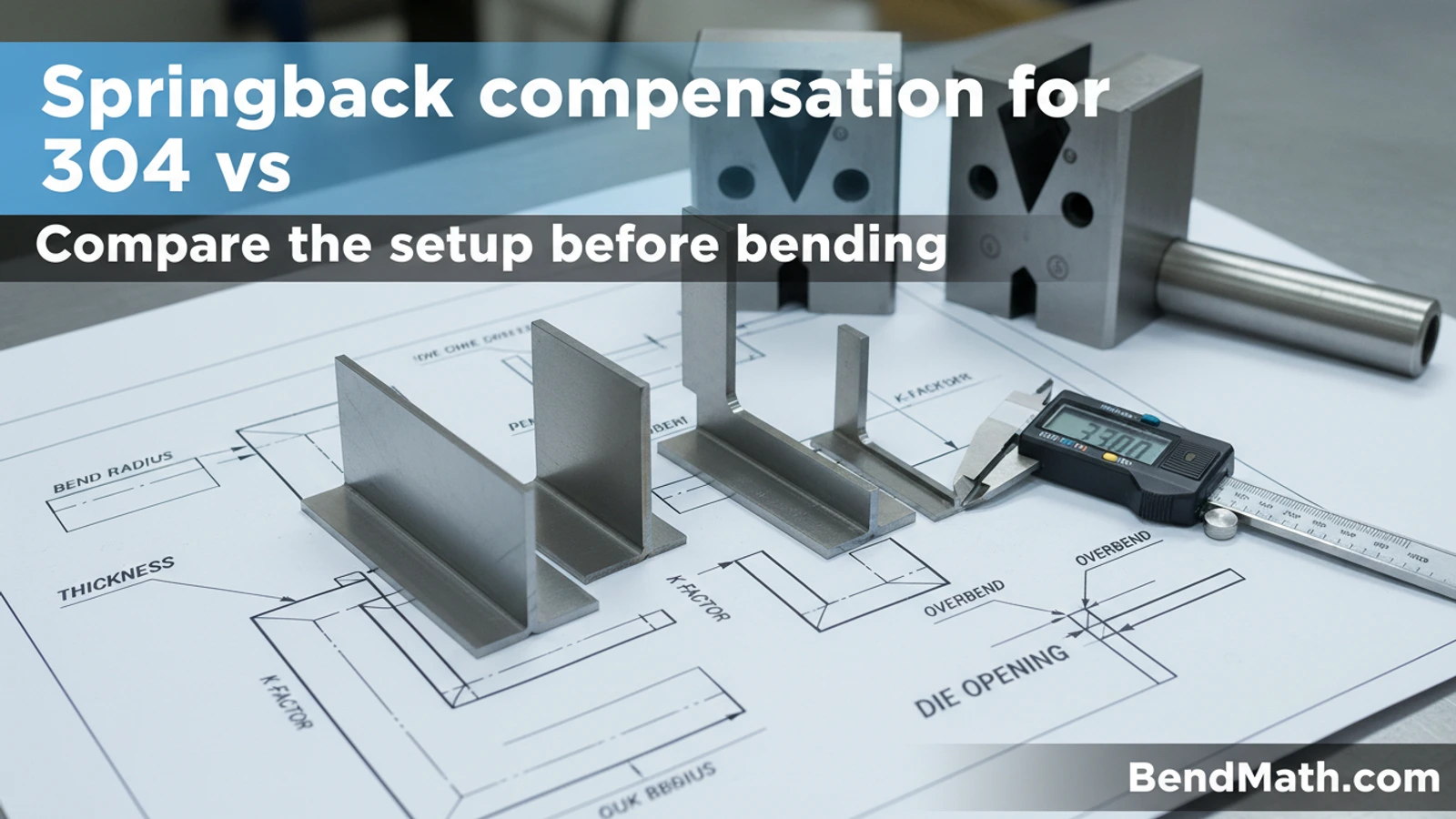
Stainless springback is a setup problem, not just a material note
304 and 316 stainless both spring back more than mild steel in typical press brake work. They also require higher forming loads and more careful radius selection. The mistake is treating "stainless" as one correction factor. The alloy, thickness, temper, grain direction, V-die opening, punch nose, and bend angle all decide how much overbend the setup needs.
304 is the common shop stainless for formed brackets, panels, and covers. 316 is chosen when corrosion resistance matters more, especially around chlorides and process environments. 316 usually runs higher strength than 304 and can demand more load and more attention to springback. That does not mean every 316 job needs a radically different flat pattern, but it does mean the first good 304 setup should not be copied without verification.
Start from the relevant combo page, such as 304 stainless 16 gauge or 316 stainless 16 gauge, then use a coupon bend to establish the actual overbend and K-factor for the tooling. Treat the calculator value as the first setup estimate, not the sign-off.
Separate angle springback from flat-pattern math
Springback compensation answers the angle question: how far must the brake overbend so the part relaxes to the target angle? K-factor answers the flat-length question: how much material does the bend region consume? They are connected through the same physical bend, but they are not interchangeable.
For example, a 90 degree final flange might require the ram to drive to an 87 degree included result before the part relaxes back to 90. That overbend does not automatically tell you the K-factor. You still need thickness, inside radius, bend angle, and measured allowance if the flat pattern must be tuned.
Stainless makes this separation important because springback can be large while the flat pattern error is still driven by radius and K-factor. If the operator changes penetration to fix angle, the produced inside radius may also shift. When radius shifts, bend allowance shifts. That is why a tight stainless job needs a setup record that includes finished angle and measured inside radius.
Compare 304 and 316 through the brake setup
Both 304 and 316 are austenitic stainless. Both work harden. Both tend to need more tonnage than mild steel. In BendMath's material defaults, 304 carries a press-brake multiplier around 1.5x mild steel and 316 around 1.6x. That is a screening number; use tooling supplier data and the brake rating before production.
The practical shop difference is that 316 often gives less margin. If the job is already near the lower radius limit, near the brake's load limit, or sensitive to cosmetic marking, 316 deserves its own coupon even if 304 behaved. The springback correction can be a few degrees, but the only number that matters is the number measured from your sheet and tooling.
Use the same V-die opening when comparing alloys. A wider die lowers tonnage but produces a larger air-bend radius and can change the overbend needed. A narrower die tightens the radius and raises tonnage. If the shop changes die opening between 304 and 316, the alloy is no longer the only variable.
Build a stainless coupon routine
Cut coupons from the actual sheet lot. Mark grain direction if it is visible or documented. Measure actual thickness. Run the first coupon with the planned punch and die. Record the programmed angle or ram position, the final relaxed angle, and the inside radius.
If the target is 90 degrees, do not stop at "close." Record whether the part relaxes to 90.5, 90.0, or 89.5. For welded assemblies or cosmetic panels, half a degree may matter. For brackets with slotted holes, it may not. The tolerance decides how much coupon work is justified.
Make a second coupon after adjusting overbend. If the second coupon lands, run the reverse K-factor check when flat length matters. If the two coupons disagree, check handling before changing the calculator: burr against the gauge stop, inconsistent grain direction, worn tooling shoulders, off-center loading, or crown variation can all show up as fake material behavior.
Use tooling choices to control risk
For air bending stainless, avoid driving a tight radius just because the punch is available. A larger V opening can reduce tonnage and surface strain, but it may increase minimum flange requirement and change the inside radius. The minimum bend radius calculator and the V-die opening calculator are starting points; stainless-specific supplier charts are still the authority.
Bottoming can reduce springback but increases load and contact. Coining can control angle further, but it is hard on tooling and material and can mark the part. For visible stainless, cosmetic requirements may rule out aggressive forming even when the machine can supply the force.
If the part has multiple bends, compensate each bend according to its radius, direction, and tooling. A long shallow bend in a wide die and a short return flange in a narrow die should not share one springback note just because both are 304.
FAQ
Does 316 stainless always spring back more than 304?
Not always in a way you can use without testing. 316 often demands more forming load and careful setup, but springback depends on actual material condition, radius, angle, tooling, and thickness. Verify with a coupon.
Should I change the K-factor to compensate for angle springback?
No. Correct angle springback with overbend or tooling strategy. Use K-factor to control bend allowance and flat length after the final formed geometry is known.
What should I record after a stainless test bend?
Record alloy, thickness, grain direction, punch radius, V-die opening, programmed angle or depth, final angle after springback, measured inside radius, and the K-factor if you solve it from the coupon.