Shop article
Why your K-factor changes between air bending and bottoming
A practical explanation of why K-factor shifts between air bending, bottoming, and coining, with shop controls for radius, tonnage, and repeatability.
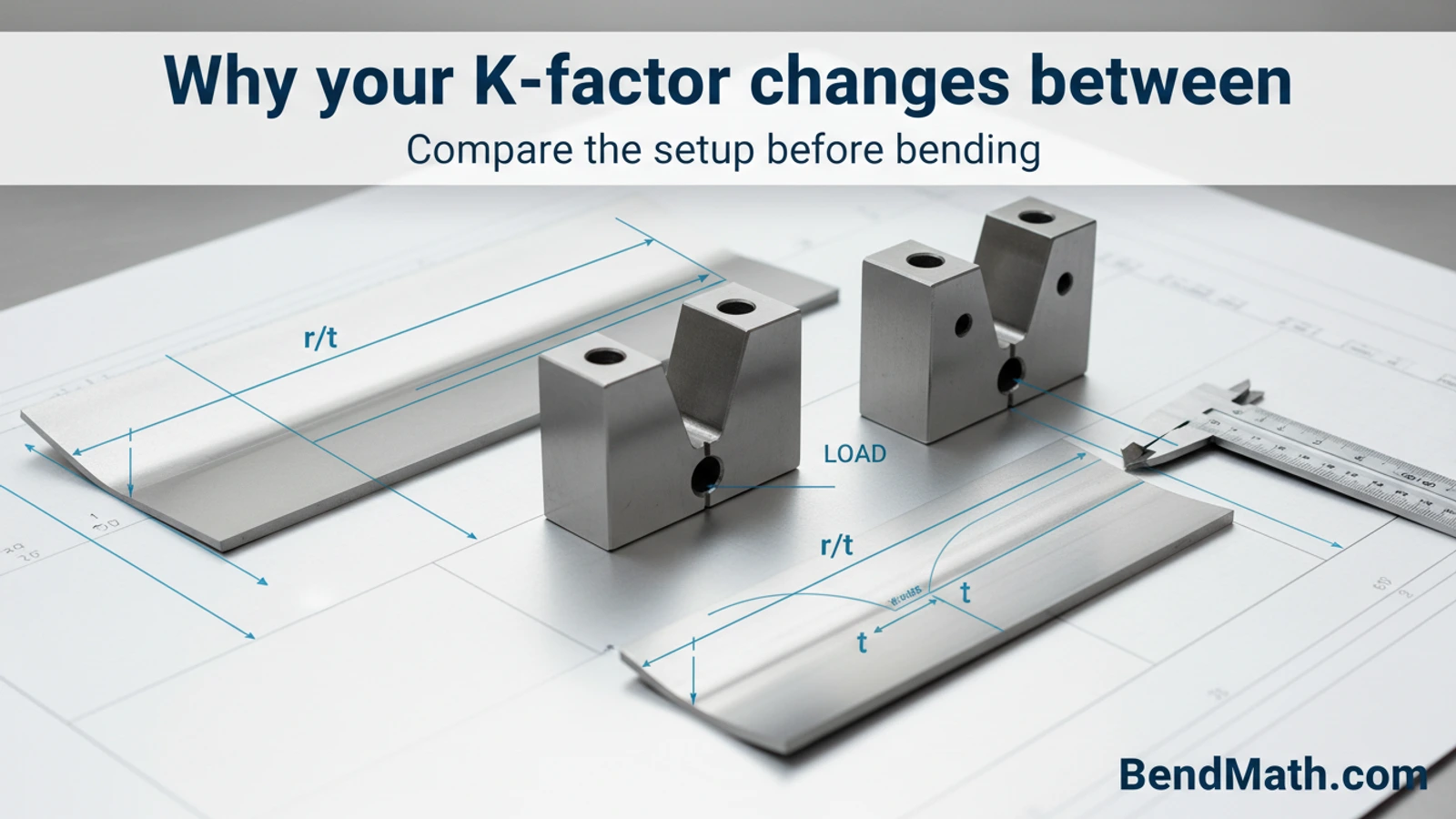
K-factor follows the forming process
K-factor describes where the neutral axis sits through the material thickness during bending. In the bend allowance formula BA = (pi / 180) x A x (r + K x t), K controls how much of the material thickness contributes to the arc length. A higher K-factor increases bend allowance and flat length. A lower K-factor shortens it.
That neutral-axis location is not fixed for a material. It moves because the strain pattern changes with tooling contact, inside radius, and how hard the sheet is driven into the die. That is why the same sheet can behave differently in air bending and bottoming even when the final angle looks the same.
Air bending forms the sheet at three main contact points: punch nose and two die shoulders. The final angle comes from depth of penetration, springback, and the elastic/plastic behavior of the material. The inside radius is often close to the common 16 percent of V opening rule, although the punch nose and material still matter. Because the bend is not forced fully into the die angle, the neutral axis can vary noticeably with V opening and radius-to-thickness ratio.
Bottoming drives the sheet into more contact with the die. The tooling angle and punch geometry assert more control, springback is reduced, and the strain field is different. Coining goes further, using high tonnage to plastically set the bend near the punch nose. As contact and compression increase, the K-factor you use for air bending should not be blindly reused.
Radius-to-thickness ratio is the first lever
The ratio r/t matters because a large inside radius stretches the material more gradually than a tight radius. When r is near one material thickness, the outer fibers strain sharply and the neutral axis tends to sit closer to the inside surface. As r/t grows, the neutral axis shifts outward toward the center of the material.
This is one reason K-factor tables often show ranges rather than one number. A 0.060 in sheet bent to a 0.060 in inside radius is not the same strain problem as the same sheet bent to a 0.250 in radius. If the shop changes from a narrow V opening to a wide V opening, the produced air-bend radius can change even though the material did not.
Use the K-factor calculator to test the sensitivity. On a 90 degree bend, increasing K from 0.38 to 0.44 at the same thickness and inside radius increases bend allowance by (pi / 180) x 90 x 0.06 x t for each 0.06 change in K. On one bend that may be small. Across six bends, or on parts with tight flange relationships, it becomes visible.
Bottoming trades springback for load and tooling dependence
Bottoming is often chosen because it improves angle control compared with air bending. The price is higher tonnage and more dependence on the exact die and punch geometry. The sheet is not just passing through three light contact points; it is being forced toward the die angle. That changes where plastic deformation concentrates.
Because bottoming requires more load, check tonnage before assuming it is the easy fix. The press brake tonnage calculator is an air-bending screening tool, so bottoming and coining require extra caution and tooling supplier data. Coining can require several times the force of air bending. If the load exceeds the punch, die, or machine rating, the K-factor discussion is secondary.
For mild steel, bottoming values often land above common air-bending starting points. Stainless can push higher again because springback and work hardening are stronger. Aluminum tempers split: ductile 3003-H14 can be forgiving, while 6061-T6 may need a larger radius before the bend is safe at all.
Grain direction and material lot still matter
Changing process does not erase material variation. Grain direction can shift the minimum radius and the repeatability of the bend, especially in aluminum. Stainless tends to spring back more and can work harden around tight radii. Coated sheet can crack at the outside fiber even when the math says the flat pattern is correct.
Thickness tolerance matters too. Gauge tables are nominal. If the sheet measures thicker than nominal, bend allowance and tonnage both move. If the sheet measures thinner, a previous bottoming setup may over-penetrate or produce a smaller inside radius. Record actual thickness when saving a shop K-factor.
The most useful process note combines material, gauge, actual thickness, grain direction, punch radius, die opening, target angle, finished angle, and solved K-factor. Without those fields, a saved value like "K = 0.42" is too vague to trust on the next job.
How to choose the starting value
Start with the process. For air bending, use the material's air-bending typical value and check the min/max range on the alloy/gauge page. For bottoming, use the bottoming range only if the tooling and load support that process. For coining, confirm machine capacity and tooling rating first, because the process can mark the material and stress the brake.
Then compare the radius. If the inside radius is much larger than thickness, expect the effective K-factor to move upward. If the radius is tight, especially near the minimum recommended radius, expect more scatter and more need for a coupon. For production, a reverse-solved K-factor from the exact setup beats a generic table every time.
Finally, decide how much tolerance the part allows. A bracket with open hole slots can tolerate more K-factor uncertainty than a cover panel with multiple return flanges that must land between welded parts. The tighter the stack, the more you should rely on coupon data.
FAQ
Is bottoming always more accurate than air bending?
Bottoming can improve angle repeatability, but only when the tooling, material, and tonnage are appropriate. It is not automatically better for flat pattern accuracy unless the K-factor is verified for that process.
Can I use one K-factor for all air bends?
Use one K-factor only when material, thickness, inside radius, grain direction, and tooling are close enough to justify it. Large radius changes and die-opening changes should be checked separately.
Why does a wider V-die change my K-factor?
In air bending, the V opening affects the produced inside radius. Changing the radius-to-thickness ratio changes the bend allowance relationship, so the effective K-factor can move even with the same material.