Shop article
How to back-calculate K-factor from a test bend
A shop-floor method for solving K-factor from a measured coupon bend, including the measurements that matter and the formula behind the reverse K-factor calculator.
Start with the reason for the coupon
A published K-factor is a starting point, not a material property. It changes with the sheet lot, temper, grain direction, punch nose, V-die opening, inside radius, and whether the operation is air bending, bottoming, or coining. If the flat pattern has to hit size without several rounds of trial blanks, the fastest path is usually a controlled test bend and a reverse K-factor calculation.
The useful output from the coupon is not a universal number for every job. It is a process value for one material, thickness, bend angle, inside radius, tooling stack, and grain orientation. For example, a 16 ga 5052-H32 coupon bent across the grain in a 0.500 in V-die may produce a different K-factor than the same material bent with a wider die or along the grain. Record the setup before recording the number.
Use the reverse K-factor calculator when you have a measured bend allowance. Use the K-factor calculator when you want to see how a chosen K-factor changes bend allowance before cutting the next blank.
Cut a coupon that matches the job
Use the same material and thickness as the production part. A coupon that is too short can be hard to measure and can be distorted by handling, so a practical shop blank is often 2 in to 4 in wide with enough leg length to measure without crowding the bend. Deburr the blank without rolling the edge. Measure actual thickness with a micrometer in a few spots and write down the average, not only the nominal gauge.
Keep the bend direction intentional. If the production flange bends across the rolling direction, bend the coupon across the rolling direction. If the drawing is close to minimum inside radius, make separate coupons along and across grain. Aluminum tempers and stainless sheet can move enough that one coupon direction is not a reliable substitute for the other.
Use the same punch, die, V opening, and press brake setup that will run the part. A test bend made in an 8T V opening does not prove the same K-factor for a 12T opening. Air bending is especially sensitive because the produced inside radius is driven by the die opening and material springback, not just the punch nose.
Measure what the formula actually needs
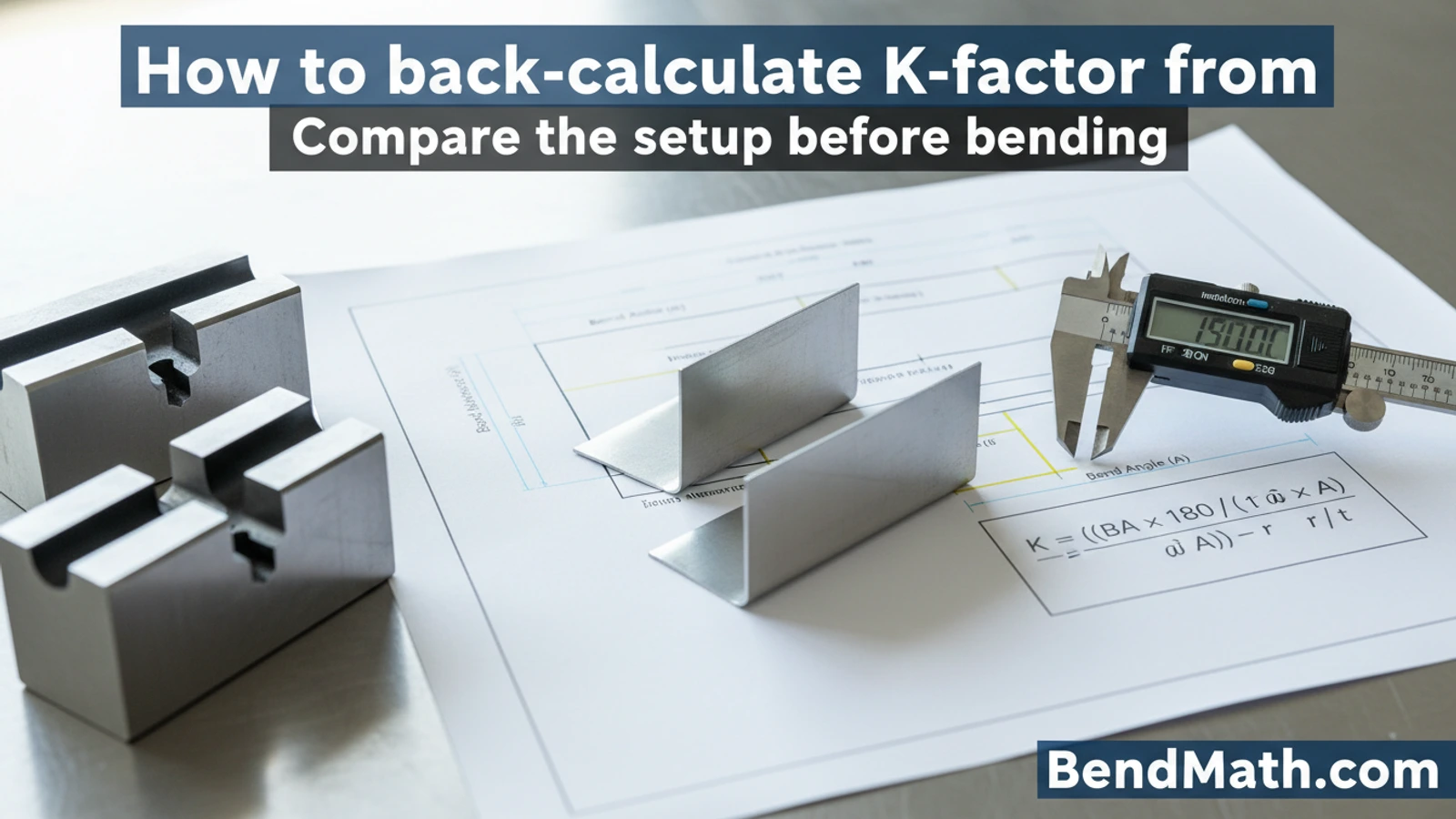
The reverse K-factor equation is the bend allowance equation solved for K:
K = ((BA x 180 / (pi x A)) - r) / t
BA is the measured bend allowance, A is the bend angle in degrees, r is the measured inside radius, and t is the measured material thickness. The angle A is the rotation angle through which the sheet is bent. For a normal 90 degree flange, A = 90. If your print gives the included angle, use A = 180 - included angle.
The hard part is usually BA. If you cut a flat coupon of known starting length, form one bend, then measure the finished leg lengths to the tangent points, BA is the amount of flat length consumed by the bend region. Many shops instead measure outside leg dimensions and use bend deduction first. That is fine, but do not mix inside and outside dimensions without converting. If the measurements are outside flange dimensions, solve the bend deduction, then convert through BD = 2 x OSSB - BA, where OSSB = tan(A / 2) x (r + t).
Measure inside radius with radius gauges or a comparator if the part size justifies it. Calipers across a small radius are often too crude. On thin sheet, an error of 0.005 in in inside radius can move the solved K-factor enough to change the flat pattern by several thousandths per bend.
Run the bend and control springback
Make the coupon to the same final angle requirement as production. If the part calls for a 90 degree bend and the brake must overbend to 87 degrees to spring back to 90, record the finished angle after springback. The calculator wants the final formed geometry, because that is what the flat pattern must produce.
Check the first coupon, then make at least one repeat. If two coupons from the same setup solve to materially different K-factors, the setup or measurement method is not controlled enough yet. Common causes are inconsistent backgauge seating, crown variation across the bed, die wear, a burr against the gauge stop, or measuring the legs at different locations across the coupon width.
For production work, do not round early. Enter thickness, radius, angle, and measured allowance with the best measurement you trust. Round the final K-factor only after the repeat coupons agree. A shop note such as "K = 0.39, 16 ga 5052-H32, 0.500 V, across grain, air bend" is much more useful than "aluminum K = 0.4."
Decide whether the result is believable
Most air-bent sheet metal jobs land somewhere around K = 0.33 to 0.50. Aluminum and mild steel often start near the low-to-middle part of that range. Stainless and large radius bends often push higher. Bottoming and coining can shift the neutral axis differently because contact and plastic deformation are different from air bending.
A solved K below 0 or above 1 is not a special material discovery. It normally means one input is wrong: the angle is the included angle instead of bend angle, the radius was measured from the wrong side, the flat length was not the original blank length, or the leg dimensions were taken outside while the math assumed tangent lengths.
If a solved value is plausible but surprising, repeat the coupon with a wider blank and mark the tangent points before forming. Also compare the result with BendMath's material range on the relevant alloy/gauge page. The range is not proof, but it is a useful sanity check before a bad measurement becomes a shop standard.
Apply the solved K-factor carefully
Once the coupon is credible, use that K-factor for the same material, thickness, bend angle range, radius, grain direction, and tooling family. For multi-bend parts, keep a setup record per bend if radii or bend methods vary. A single K-factor across every bend on a part is convenient, but it is only defensible when the bends are actually made the same way.
When the part changes gauge, die opening, or material lot, expect to re-check. A quick coupon costs less than chasing a flat pattern across a nested sheet. For high-value parts, keep the coupon, the first accepted part, the flat pattern revision, and the brake setup sheet together so the next run starts from evidence instead of memory.
FAQ
Can I back-calculate K-factor from a finished production part?
Yes, if you can reconstruct the original flat length or accurately measure the bend allowance from the finished geometry. If you only have outside dimensions and no reliable inside radius, solve the missing geometry first or make a new coupon.
How many coupons are enough?
For routine work, two matching coupons are a practical minimum. For tight tolerance work, run coupons from the actual sheet lot and measure across the width so crown, grain, and handling variation show up before production.
Should I use the same K-factor for bottoming and air bending?
No. Air bending, bottoming, and coining deform the bend differently. Use a coupon from the same process you intend to run, then store the K-factor with that process name.